
Key Takeaways
- Start with the room’s main need, not only the treatment’s appearance.
- Observe each window at different times of day before choosing an opacity or style.
- Use adjustable treatments when glare and privacy needs change throughout the day.
- Consider layering when one product cannot provide both daylight and nighttime coverage.
- Measure carefully, account for hardware and trim, and choose the right mounting style.
- Prioritize cordless operation in homes with children or pets.
Choosing window treatments in The Seacoast, New Hampshire, means looking beyond color and pattern. A street-facing Portsmouth living room, a sunlit home office in Dover, and a bedroom near the coast can all require different solutions for glare, privacy, changing daylight, and everyday comfort. If an existing shade will not raise, tilt, or stay in place, professional blind repairs in The Seacoast (NH) may be worth considering before replacing the entire treatment.
The right choice begins with what each window needs to do. Some windows need softer light for reading or video calls. Others need more privacy after dark, better coverage in early morning sunlight, or a material that withstands kitchen moisture and frequent cleaning.
For Seacoast households, window direction matters. East-facing rooms may receive strong morning sun, while west-facing windows can create late-day glare during dinner, work, or television time. Bright winter light and reflection from snow can also make an otherwise comfortable room feel visually harsh. The New Hampshire coast’s reflective snow cover and extended winter season make this consideration especially important for homes throughout the Seacoast region.
Before shopping, write a quick window brief for every opening: identify the room, its direction, the hours when light is difficult, the desired privacy level, and any concerns about temperature, moisture, pets, or furniture placement. This small step makes comparisons much easier.
When a damaged lift mechanism or uneven slats are the main issue, searching for window blind repairs near me can help homeowners evaluate whether a repair is a practical alternative to replacement.
Start with the Windows’ main job
A window treatment should solve a real problem. That may be reducing glare on a laptop, preventing passersby from seeing into a first-floor room, protecting a favorite chair from direct sun, or helping a bedroom stay darker in the morning. One home rarely needs the same product everywhere. A scenic window may benefit from a view-preserving shade, while a nursery may need stronger light control and simple, safe operation.
Study the Light Before Choosing a Style
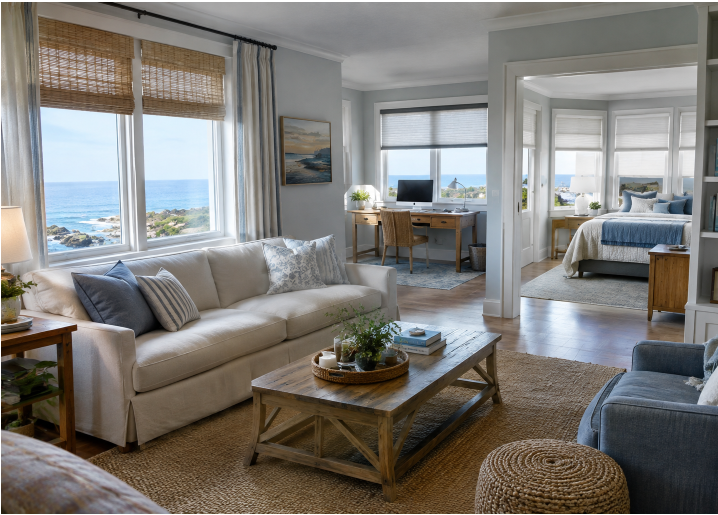
Watch each window in the morning, afternoon, and evening. East-facing windows often need early-day control, while west-facing windows can be difficult when the sun sits lower later in the day. South-facing rooms may receive prolonged direct light, and north-facing rooms generally receive gentler, more indirect light. Test samples in the actual room, because fabric that appears airy in a showroom can look much darker against a shaded Seacoast interior. The unique lighting conditions of The Seacoast, shaped by its proximity to the Atlantic Ocean and maritime environment, can affect how colors and materials perform across the seasons.
Compare Light-Control Levels
- Sheer: Softens sunlight and preserves an open feel, but offers limited privacy at night.
- Light-filtering: Cuts harsh brightness while allowing useful daylight into living areas and offices.
- Room-darkening: Reduces a substantial amount of incoming light for bedrooms and media spaces.
- Blackout: Offers the darkest coverage when the product has adequate overlap and is installed to minimize edge gaps.
- Adjustable: Blinds, shutters, and certain shades allow users to redirect or reduce light without fully covering the window.
Fabric alone does not determine performance. Light can enter at the sides, top, and bottom of an inside-mounted treatment, so mounting and overlap deserve as much attention as the material itself.
Match the Treatment to Each Room
Living Rooms and Home Offices
Living rooms usually need a balance of view, glare control, and evening privacy. Roller shades, solar-style materials, shutters, blinds, and drapery can all work depending on the room. In a home office, adjustable coverage is especially useful because screens, video calls, and changing daylight do not always cooperate. A shade that can be adjusted to different heights can help block direct glare while still allowing some natural light.
Bedrooms, Children’s Rooms, and Play Areas
Bedrooms often benefit from room-darkening or blackout shades, lined drapery, cellular shades, or a layered combination. For children’s rooms and play areas, cordless designs remove accessible operating cords and simplify daily use. Durable, easy-clean materials are useful where fingerprints, pets, and active play are part of normal life.
Kitchens and Bathrooms
Choose materials that tolerate humidity and wipe clean easily. Treatments should also clear faucets, cabinet doors, window cranks, counters, and ventilation areas. A compact shade or moisture-tolerant blind is often easier to manage than long fabric panels near sinks or cooking surfaces. For Seacoast homes, where salt air and coastal humidity can accelerate corrosion and moisture damage, moisture-resistant materials and finishes are particularly valuable.
Balance Privacy and Daylight
Daytime privacy is different from nighttime privacy. A sheer may obscure views into a room during the day, yet become far less private when interior lights are on after dark. Top-down, bottom-up shades can be helpful for Seacoast homes near neighboring houses or sidewalks, as they can block eye-level views while leaving the upper portion of the window open for daylight. Outside-mounted shades or drapery can also provide extra coverage around the edges.
Consider Temperature and Energy Comfort
Window treatments can help manage glare, unwanted solar heat, wintertime discomfort near glass, and nighttime privacy. The window attachment guidance for solar control and energy efficiency from the Building America Solution Center notes that shades, blinds, drapes, shutters, and similar attachments can support comfort when selected and operated for the conditions at each window. Results depend on the window itself, orientation, fit, material, and how consistently the treatment is used. Coverings also cannot correct failed window seals, major drafts, or damaged frames.
When Layered Treatments Make Sense
Layering is useful when a room needs more than one function. A light-filtering shade can soften daytime sun, while lined drapery can add evening privacy and a more finished appearance. Bedrooms, street-facing living rooms, and rooms with challenging glare are common candidates. Before choosing layers, confirm there is enough wall width, depth, and hardware clearance for both treatments to operate independently.
Measure, Mount, and Add Practical Features
Choose the Right Mount
An inside mount creates a clean, built-in look, but it requires sufficient window depth and may leave small light gaps. An outside mount covers more of the wall area around the opening, making it helpful for shallow frames, uneven openings, or windows that need stronger privacy and light control.
Use a Final Selection Checklist
- Measure width and height more than once, and label every window clearly.
- Check trim, locks, handles, furniture, and nearby doors before ordering.
- Confirm the overlap required for privacy and room-darkening performance.
- Consider cordless operation or motorization for tall, wide, or hard-to-reach windows.
- Plan for batteries, charging, wiring, remotes, or wall controls before selecting automated shades.
The best window treatment for a Seacoast home is one that suits the room’s real routine and withstands the region’s coastal environment. By weighing daylight, glare, privacy, comfort, maintenance, safety, and mounting details before focusing on style, homeowners throughout The Seacoast can choose treatments that look polished and work well through every season.